
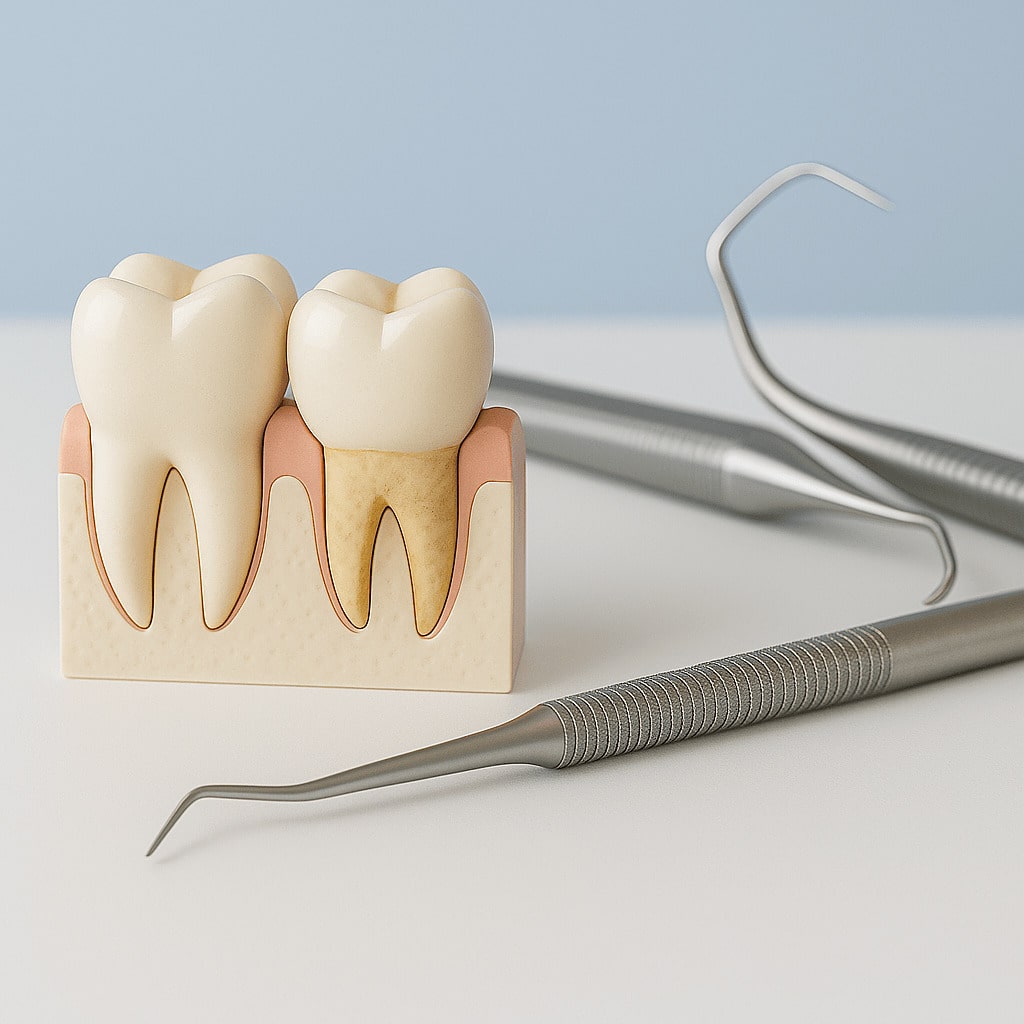
Periodontal treatment at Agat Dental is aimed at preserving gum health and preventing diseases that can lead to tooth loss. Periodontal conditions develop gradually and often without noticeable symptoms, which is why our clinic pays special attention to early diagnosis. Modern diagnostic methods allow us to detect inflammation, tissue damage, and bite disorders at the earliest stages. We apply a comprehensive approach that includes professional hygiene, ultrasonic removal of tartar, deep cleaning of periodontal pockets, laser therapy, and individual treatment plans. When necessary, we perform tissue regeneration and strengthening of the tooth’s supporting structures. All procedures are carried out gently, using safe technologies and high-quality materials. Doctors at Agat Dental tailor treatment according to each patient’s individual needs, disease stage, and oral health condition. Our methods help reduce sensitivity, eliminate bleeding and bad odor, and prevent further tissue destruction. After completing treatment, we continue supervising the patient’s progress and provide guidance on proper home care to maintain long-term results. Periodontal treatment at Agat Dental ensures healthy gums, strong teeth, and a beautiful smile for years to come.
There is a saying: “Periodontal diseases are the silent killers of teeth.”
Indeed, sooner or later these problems can lead to tooth loss.
The real danger lies in the fact that the early stages of the disease often progress without symptoms — meaning they go unnoticed by the person. Symptoms such as dental deposits, bleeding gums during brushing, or bad breath are often perceived by patients as minor issues not worth attention.
The causes of such diseases are sometimes obvious, and sometimes almost impossible to determine precisely. All causes can be divided into local and general.
Local causes include unfavorable factors directly in the oral cavity (poor hygiene, excessive dental deposits, poorly placed fillings and prosthetic constructions, external mechanical irritants, etc.).
General causes include various diseases of internal organs and systems (endocrine disorders, gastrointestinal diseases, blood disorders, immune system deficiencies, etc.).
Methods of treating periodontal diseases
Methods of treating periodontal diseases are divided into conservative (therapeutic) and surgical.
The choice of treatment method depends on the disease, its stage, and any existing accompanying pathologies. Sometimes regular therapeutic procedures are sufficient, while in other cases surgical intervention is necessary.
Gingivitis
Gingivitis is inflammation of the gum, in which periodontal pockets have not yet formed.
Symptoms of acute gingivitis include swelling, redness, gum tenderness, bleeding during eating and brushing. Sometimes ulcers may appear on the gums.
Periodontitis
Periodontitis is inflammation of the gums that spreads from the mucosa to all the tissues surrounding and supporting the teeth in the jawbones.
As a result, the tooth–gum connection is destroyed, and the volume of bone tissue around the teeth decreases, which can lead to loosening and tooth loss.
Without proper treatment, the depth of periodontal pockets increases, bone tissue undergoes atrophy, and the roots of the teeth become exposed. Once the roots are exposed, increased sensitivity to temperature changes and chemical irritants may occur.
Periodontosis
With periodontosis, there is usually no gum bleeding or inflammation, periodontal pockets do not form, there is no loosening of teeth, and bad breath is minimal or absent.
Most often, the main cause of periodontosis is atrophy of the alveolar processes (jawbone tissue), which leads to uniform gum recession and exposure of the tooth roots (without tooth mobility).
Treatment of periodontal disease
Treatment of periodontal diseases depends on the cause and the degree of progression.
First, it is necessary to identify and, if possible, eliminate the causes of the disease (treat the underlying condition, replace defective fillings and crowns).
Then professional oral hygiene must be performed: remove soft and hard dental deposits, and only after that can local and general treatment be prescribed.
If gingivitis or mild periodontitis is present (when periodontal pockets are not very deep), dental deposits are removed using standard methods (ultrasound, air-abrasive devices, and manual instruments such as scalers).
If the depth of periodontal pockets is 4–6 mm, this is considered a moderate degree of severity.
In this case, it is impossible to reach the deposits located at the bottom of the pockets using ordinary instruments.
To properly remove all plaque and calculus, small incisions must be made in the gums to lift their edge and clean all the periodontal pockets.
If periodontitis is severe — pockets deeper than 6 mm, bone height reduced by more than half the root length, and significant tooth mobility — surgical treatment is required.
The surgery that allows cleaning deep periodontal pockets from deposits and reducing their depth is called flap surgery.
Agat Dental Clinic is one of the few clinics in Yerevan that offers a wide range of periodontal surgeries, performed by a highly qualified periodontist trained at New York Medical University.
The clinic also periodically hosts consultations with a professor of the Department of Periodontology and Implantology at New York Medical University.
Flap Surgery
During this procedure, the doctor gains direct access to the periodontal pocket and the tooth root. Flap surgery is performed under local anesthesia.
The procedure consists of making several incisions in the gum, resulting in the formation of a flap. This flap is lifted, giving access to the tooth root. This allows the doctor to clean the root from dental calculus, polish it, and remove all pathological tissues in the periodontal pocket. If necessary, bone grafting is performed to increase the size of the alveolar process. For better bone regeneration and for improved reattachment of the gum to the tooth, special gels and membranes are sometimes placed under the flap. After all necessary manipulations, the doctor sutures the gum flap back into place. The postoperative period usually lasts several days. It is necessary to follow all the doctor’s instructions. Typically, the doctor gives the following recommendations:
- Take pain relievers if necessary.
- To reduce swelling and pain in the area of the postoperative wound, rinse the mouth gently with a weak solution of salt and baking soda, as well as special antiseptics.
- Avoid physical activity to prevent bleeding.
- Eat only soft foods at first.
- Brush your teeth carefully.
- You may apply cold to the cheek in the area of the surgery (for example, an ice pack).
- Limit smoking.
Bone Grafting
Bone grafting is used when bone loss due to periodontal disease is significant and the bone volume needs to be restored. This procedure is usually combined with flap surgery. A bone graft is placed under the flap. It may be either artificial bone or bone tissue taken from another area of the patient’s jaw. After the flap is sutured, the graft gradually integrates, increasing the volume of bone tissue around the tooth.
Frenulum Surgery (Frenuloplasty) of the Lips and Cheeks
Just as with a shallow vestibule of the oral cavity, short frenula of the lips or cheeks lead to constant tension of the oral mucosa. This tension causes gum recession and exposure of the tooth necks. To eliminate this tension, frenulum surgery must be performed. It is carried out surgically by making several incisions followed by suturing. The procedure is performed under local anesthesia and is well tolerated by patients. The healing period is only 3–7 days.
Vestibuloplasty (Increasing the Depth of the Oral Vestibule)
Often, gum disease is caused by a congenitally shallow oral vestibule. This means that the junction of the gum mucosa with the lip or cheek (the so-called transitional fold) is located very close to the gum margin and the tooth necks. During lip and cheek movements, the mucosa is constantly under tension. Over time, this tension causes the gum to retract, exposing the necks and roots of the teeth. To reduce this chronic tension, special incisions are made in the area of the transitional fold. After these incisions heal, the fold moves away from the gum margin, and the tension of the mucosa decreases.
Medication Treatment
Medication treatment is selected individually. The doctor may prescribe both local and systemic therapy.
Local procedures:
applications and compresses with medicinal products; applying special films, gels, and ointments to the gums; rinsing the mouth with various solutions; gum massage; physiotherapy procedures; regular use of special toothpaste, etc.
Systemic treatment:
taking antibiotics, vitamins, medications that improve circulation and immunity, antioxidants, dietary supplements, homeopathic remedies, etc.
Splinting
Since one of the most unpleasant symptoms of periodontitis is pathological tooth mobility, splinting is often required (i.e., connecting the teeth into a single block, fastening them together). As a result, each tooth becomes less mobile because it is “supported” by adjacent teeth.


