
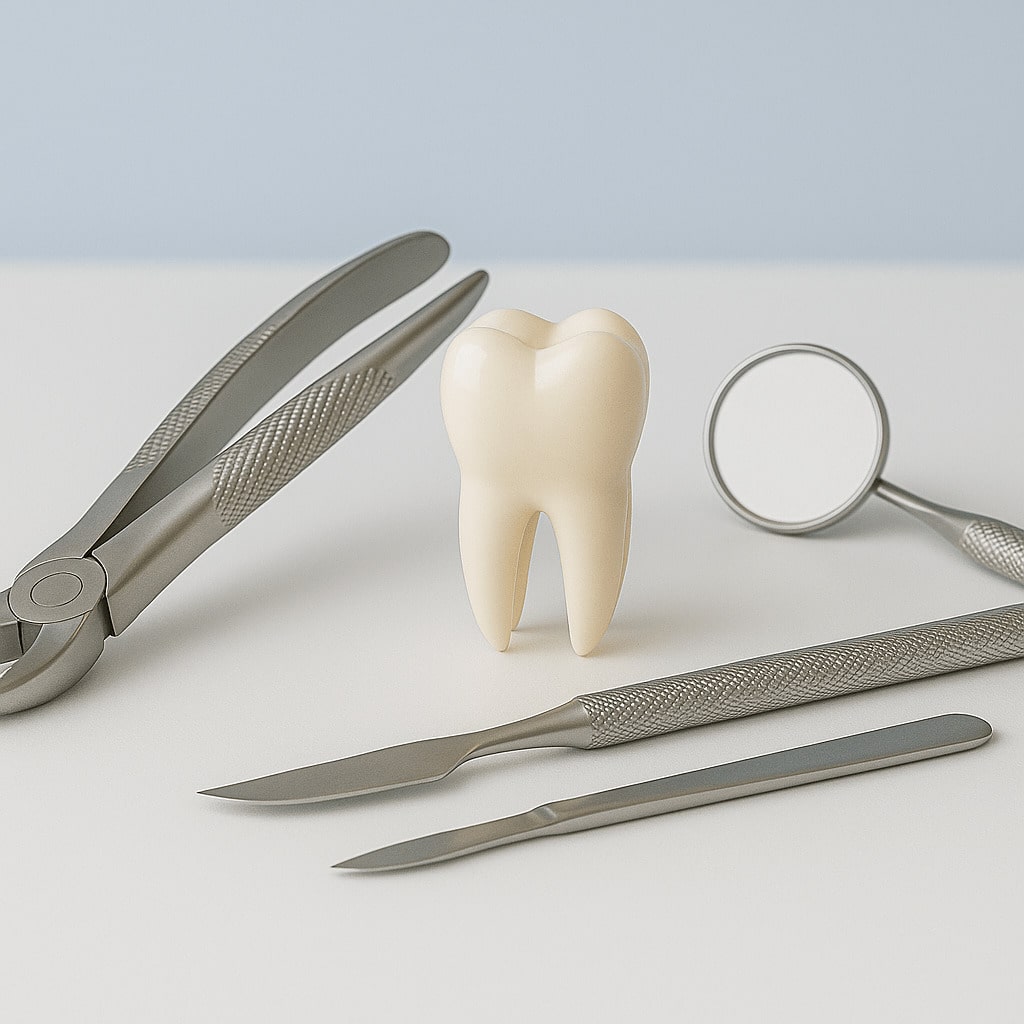
Modern surgical care in our clinic is built on safety, precision, and the most gentle treatment methods. All surgical procedures are performed using advanced equipment, allowing interventions to be carried out quickly, accurately, and with minimal discomfort. We place great emphasis on accurate diagnostics to choose the best treatment strategy for every patient. Our surgeons perform extractions of any complexity, including impacted and mispositioned wisdom teeth. We also provide surgical treatment for cysts, granulomas, periodontal conditions, and prepare the oral cavity for implantation. All procedures are performed under modern anesthesia to ensure maximum comfort. We give special attention to the postoperative period, offering clear guidelines for fast and safe recovery. Thanks to our surgeons’ experience and strict sterilization standards, risks are minimized and healing is accelerated. Patients appreciate our attentiveness, professionalism, and the high quality of surgical care. Surgical treatment in our clinic is a combination of technology, expertise, and care focused entirely on your health and comfort. Trust our doctors, and we will provide a safe and effective solution even for the most complex dental cases.
A cyst is an enlarged dental granuloma (greater than 0.5 cm in diameter). The development of such a formation inside the bone often progresses without symptoms for many years. Therefore, a cyst is usually discovered either accidentally on an X-ray or only after it ruptures and its contents spread into the bone.
The appearance of a sac filled with pathological fluid at the root tip may be caused by several factors:
- Untreated complicated caries — pulpitis or periodontitis
- Trauma to the tooth, particularly a root fracture
- Poor-quality root canal treatment
Cyst treatment methods.
In the early stages of cyst development, therapeutic treatment is possible, such as the introduction of copper ions into the root tip — a procedure known as depophoresis.
If conservative methods do not produce the desired effect, surgical intervention is performed using one of the following operations: cystotomy, cystectomy, or apicoectomy (root tip resection).
Cystectomy is a radical surgery in which the cyst and its membrane are completely removed, followed by tight tissue closure.
Cystotomy is a surgical method in which the front wall of the cyst is removed and the remaining cavity is opened into the vestibule or the oral cavity itself. This procedure is less traumatic and better tolerated by patients, but it has a longer postoperative healing period.
Causes of jaw periostitis
- Diseased teeth are the most common source of jaw infection.
- Untreated inflammatory diseases of the teeth can lead to infection spreading to the jawbones.
- Pathogenic microorganisms may enter the jaw through wounds, such as open jaw fractures or large infected soft-tissue injuries of the face.
- In rare cases, infection penetrates the jaw through blood or lymph vessels from other inflammatory sites (e.g., tonsillitis or infectious diseases), mostly in children.
- Most commonly, jaw periostitis occurs as a complication of periodontitis or after tooth extraction, especially when preceded by hypothermia, flu, tonsillitis, etc.
Treatment of periostitis in a dental clinic is most often performed surgically.
After local anesthesia, the abscess is opened, and to ensure better drainage of the pus, a special rubber drain (strip) is inserted into the wound for 2–3 days.
Pericoronitis is an inflammatory process of the gum tissues surrounding an erupting tooth. It usually affects the gum tissues around the lower wisdom teeth.
Why can a person experience difficulty with tooth eruption, especially wisdom teeth?
There may be several reasons. The most common include:
- Incorrect position of the wisdom tooth (it grows “sideways,” pressing its chewing surface against the neighboring tooth).
- Incorrect position of the tooth roots.
- Thickening of the dental follicle wall (which surrounds the tooth crown).
- Thickening of the gum mucosa, making it difficult for the tooth to break through.
Surgical treatment of pericoronitis is performed as follows:
The doctor incises the infected portion of the gum flap. The pus is carefully removed, and the incision is rinsed with antiseptics. Naturally, all surgical procedures are performed under local anesthesia.
Frenulum
In the vast majority of cases, a gap between the front teeth forms as a result of a short upper lip frenulum.
Before braces are placed, this obstacle must be removed to allow the teeth to move together.
The upper lip frenulum is a fold of mucous tissue that forms at the transition of the lip into the gum.
If the frenulum is short, too dense, or attached too close to the teeth, a patient may experience the following cosmetic and functional problems:
- A gap between the front teeth (diastema).
- A less expressive smile due to the inability to fully move or raise the upper lip.
- Speech defects or difficulty pronouncing certain sounds.
- The frenulum pulls the interdental papilla, leading to irritation, gum recession, and exposure of tooth necks in older patients.
- In children with mixed dentition, it may cause the front teeth to protrude forward.
For a doctor skilled in modern treatment techniques, eliminating the gap between the front teeth is not difficult: it is necessary to remove the cause — the short upper lip frenulum (if this is the cause of the diastema) — and also eliminate the consequence — the gap between the teeth.


